-
- No matching results found.
- Watch history
- Download
- High (1080p)
- Medium (720p)
- Low (540p)
- Audio
- Original
The Neuroscience of Play
an IDEA Centre webinar featuring Eva de Gosztonyi - February 2023
Neuroscience of Play
February 28, 2023
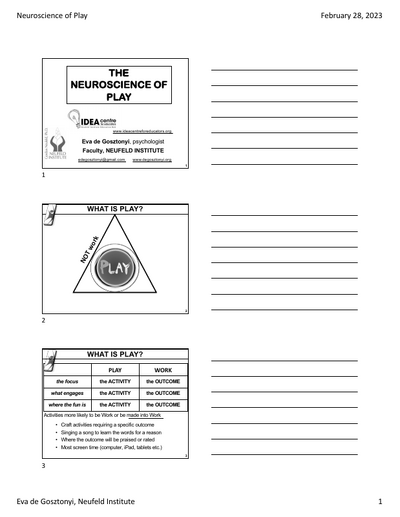
THE NEUROSCIENCE OF PLAY
IDEAcentre for educators
www.ideacentreforeducators.org
Eva de Gosztonyi, psychologist
NEUFELD Faculty, NEUFELD INSTITUTE
WHAT IS PLAY?
NOT work
WHAT IS PLAY?
| PLAY | WORK |
|---|---|
| the focus | the ACTIVITY |
| what engages | the ACTIVITY |
| where the fun is | the ACTIVITY |
Activities more likely to be Work or be made into Work:
- Craft activities requiring a specific outcome
- Singing a song to learn the words for a reason
- Where the outcome will be praised or rated
- Most screen time (computer, iPad, tablets etc.)
Eva de Gosztonyi, Neufeld Institute
Neuroscience of Play February 28, 2023
WHAT IS PLAY?
NOT work NOT for real
CONSEQUENCE AND RISK-FREE
4
WHAT IS PLAY?
NOT work NOT for real
Expressive and exploratory
AN OUTFLOW OF ENERGY
5
ENGAGING
NOT work NOT for real
SAENY expressive FaM
Gordon Neufeld, PhD
6
Eva de Gosztonyi, Neufeld Institute
Neuroscience of Play
KEY CONCEPT # 1
THE BRAIN TAKES TIME TO DEVELOP
- Many parts of the brain need to create connections to work together
- We must create the conditions for growth of all the parts of the brain
BRAIN DEVELOPMENT
HOW LONG DOES IT TAKE TO “GROW” A FULLY FUNCTIONING HUMAN BRAIN?
AT LEAST 25 YEARS – IF ALL GOES WELL
MUCH LONGER, ESPECIALLY IF EXPERIENCING STRESS AND TRAUMA
J. Giedd, L. Steinberg, etc.
THE BRAIN
| PREFRONTAL | CORPUS CALLOSUM | LEFT & RIGHT HEMISPHERE |
|---|---|---|
| TWO THOUGHTS | CONNECTS THE LEFT AND RIGHT PARTS | OF THE BRAIN |
| only starts to engage at the age | of 5 years-old |
Eva de Gosztonyi, Neufeld Institute
Neuroscience of Play February 28, 2023
THE BRAIN
Birds and animals all have divided brains,
| LEFT HEMISPHERE | RIGHT HEMISPHERE |
|---|---|
| for the narrow attention that enables them to lock onto whatever it is they need to get. e.g. seed amongst pebbles | for vigilant attention to the world at large, so as to make sense of it, on the look-out for whatever else may exist – e.g. in order to avoid getting eaten |
THE BRAIN
RIGHT HEMISPHERE
LEFT HEMISPHERE
-
is used to grasp and manipulate
-
Its raison d’être is to narrow things down to a certainty.
-
It sees things as fixed and static and isolated and atomistic.
-
is used to understand the world at large and how things within it relate to one another, as well as our relationship with it as a whole.
-
Its raison d’être is to open things up into possibility.
-
It appreciates that all things change and flow and are interconnected.
There is evidence that those of highest intelligence, whatever their discipline, may rely more on the right hemisphere.
THE BRAIN
The right hemisphere:
- sees more
- is more in touch with reality
- is more intellectually sophisticated.
The left hemisphere:
- does not understand things, so much as process them.
It is the right hemisphere that is the basis of understanding.
I believe there has been until very recently a blindness among neuroscientists to the contributions made by the right hemisphere. (p. 129) McGilchrist
Eva de Gosztonyi, Neufeld Institute
Neuroscience of Play
THE BRAIN
LEFT HEMISPHERE
- learns facts
- de-contextualized
- focus is on details and rules
- abstract
- wants THE answer
RIGHT HEMISPHERE
- looks at the whole picture
- makes sense of the details
- considers context
- seeks understanding
Right hemisphere is in rapid development during early childhood.
RIGHT HEMISPHERE REQUIRES EXPERIENCES NOT INFORMATION TO DEVELOP
AND THUS, THE NEED FOR PLAY
13
THE BRAIN
CORPUS CALLOSUM
Corpus callosum
- undergoes a growth spurt between ages 3 and 6,
- results in improved coordination between right and left hemisphere tasks.
In comparison to other individuals, children younger than 6 demonstrate difficulty coordinating an Etch-A-Sketch toy because their corpus callosum is not developed enough to integrate the movements of both hands. (Kalat, 2016).
14
THE BRAIN
PRE-FRONTAL CORTEX
Allows for conflicting THOUGHTS and FEELINGS
on the one hand on the other hand
IMPULSE CONTROL
- my needs
- the needs of others
SOCIAL PROBLEM SOLVING
- only starts to engage between 5 -7 years
- does not stabilize until the mid 20’s of age
- is ”glitchy” in the teen years
- development is slowed by childhood trauma
DELAY OF TIME
EMOTIONAL MANAGEMENT
REGULATION
15
Eva de Gosztonyi, Neufeld Institute
5
Neuroscience of Play
KEY CONCEPT # 2
PLAY PROVIDES THE IDEAL CONDITIONS FOR BRAIN DEVELOPMENT
PLAY AND THE BRAIN
FOCUS and ATTENTION
Diamond, 2013
Sustained engagement in an activity demands the ability to stay selectively focused on the situation at present, tune out distractions, and hold the information in our heads.
Play provides the ideal situation for a child to develop this kind of focus.
PLAY AND THE BRAIN
EXECUTIVE FUNCTIONS - ATTENTION
Lillard & Else-Quest, 2006, as cited in Carlson, Zelazo, & Faja, 2013
They observed the effects of active engagement on executive function skills (EFs) in a study comparing children assigned to Montessori and non-Montessori schools. The Montessori children, who had fewer interruptions during their learning (self-directed play) activities, performed better at EF tasks than the other group.
Eva de Gosztonyi, Neufeld Institute
Neuroscience of Play February 28, 2023
PLAY AND THE BRAIN
PREFRONTAL CORTEX (PFC)
Panksepp 2007
In addition, in humans, play facilitates the maturation of the frontal lobe inhibitory skills that enable a child to reflect, look, listen, and feel before acting on primary-process emotional urges. This promotes empathy, imagination, and creative play.
Gwen Gordon – Play - 471
PLAY AND THE BRAIN
SELF-REGULATION AND READING SOCIAL CUES
“One function of play is to take you to the edge of your emotional knowledge, so you can learn what you can and cannot do to others.”
Jaak Panksepp: Brain World
PLAY AND THE BRAIN
SELF-REGULATION AND READING SOCIAL CUES
Panksepp 2004; Pellis 2010
Behavioural neurobiologists have found that:
ROUGH AND TUMBLE PLAY, which can ride the edge of ambiguity and requires continual reassurances, generates the neural circuits that enable animals to ACCURATELY READ AMBIGUOUS SOCIAL SIGNALS, thus building their social intelligence and capacity for relationship.
Eva de Gosztonyi, Neufeld Institute
Neuroscience of Play February 28, 2023
PLAY AND THE BRAIN
SELF-REGULATION AND READING SOCIAL CUES
According to complexity science, this dynamic process of integration occurs at the edge of chaos, with enough order to provide stability but enough dynamism for the system to continually adapt and grow. Such an integrated slate enables a system to move toward "maximizing complexity," a state that represents the system's optimal functioning. According to Siegel (2001), optimal functioning systems are ”flexible,” "adaptive," ”coherent,” “energized,” and stable" which he identifies through the acronym FACES.
Gwen Gordon – Play - 470
PLAY AND THE BRAIN
PREFRONTAL CORTEX (PFC)
Bell, Pellis, & Kolb 2010; for reviews also see Pellis & Pellis, 2007; Pellis, Pellis, & Himmler, 2014
Social interactions in rodents characterised as ROUGH-AND-TUMBLE PLAY appear to shape the PFC (Prefrontal Cortex) and have an impact on self regulation and planning.
Gwen Gordon – Play - 471
PLAY AND THE BRAIN
Emily Freeman et al. 2022
Her study contributed to the field of child development by demonstrating strong links between father-child rough-and-tumble play and children's working memory capacity. The frequency and quality of rough-and-tumble play was associated with better working memory capacity and fewer working memory problems.
Jennifer St. George et al. 2021
The benefits of paternal play for the child's academic performance are in addition to other benefits for the child's emotional regulation, social adjustment, and mental health.₂₄
Eva de Gosztonyi, Neufeld Institute
Neuroscience of Play February 28, 2023
THE ROLE OF PLAY IN DEVELOPMENT
EMERGENT PROCESS – THE SELF
Play is where the SELF is truly expressed.
THE CHILD’S CREATIVITY
- desires
- want-to’s
- curiosity
- intentions
- initiatives
- aspirations
DISCOVERY
- expression
- personal meaning
EXPLORATION
Where the child creates a sense of WHO he/she IS.
25
THE ROLE OF PLAY IN DEVELOPMENT
INTEGRATIVE PROCESS - OTHERS
Play is where inner conflict first arises.
THE CHILD
- figures things out
- dares to make mistakes
- notices similarities & difference
- uses trial & error
- learns to get along with others
DISCOVERY
DISSONANCE
A leap from purity & impulsiveness into a world of inner conflict.
26
THE ROLE OF PLAY IN DEVELOPMENT
ADAPTIVE PROCESS - RESILIENCE
Playing with separation, lack and loss.
THE CHILD
- flirts with difficult emotions
- imagines the unimaginable
- feels sadness “one step removed”
- able to tolerate the adaptive process – going down and rebounding
EXPLORATION
SADNESS
RECOVERY
A leap from weakness & fragility into strength & resilience.
27
Eva de Gosztonyi, Neufeld Institute 9
Neuroscience of Play
KEY CONCEPT # 3
A LACK OF PLAY TIME IN THE EARLY YEARS SEEMS TO AFFECT MENTAL HEALTH, BEHAVIOURAL AND ACADEMIC OUTCOMES
LOSING THE SPACE TO PLAY
David Elkind in the Power of Play
- Over the past two decades, children have lost twelve hours of free time a week, including eight hours of unstructured play and outdoor activities.
- Free unstructured play, spontaneous pickup games, and self-initiated dramatic play, are replaced by digital devices.
Stuart Brown on the Status of Play (Encyclopedia of Play Science)
- Outdoor play has decreased by 71% in one generation in both the US and the UK.
ESCALATING DIAGNOSES OF CHILDHOOD ANXIETY, DEPRESSION AND ADHD HAS PARALLELED THE LOSS OF PLAY
Peter Gray, 2011
PLAY and EMOTIONAL WELL-BEING
When children are “stirred up” emotionally, their PLAY can reflect themes they are struggling with.
PLAY is how they naturally make sense of all the emotions they are experiencing.
In PLAY, pictures are drawn, structures are made, and games are engaged in to ALLOW EMOTIONS TO COME OUT in a way that feels “safer”.
Eva de Gosztonyi, Neufeld Institute
Neuroscience of Play February 28, 2023
PLAY and EMOTIONAL WELL-BEING
Dr. Porges describes play as
- a “neural exercise” healing behavioral and emotional dysregulation.
- a necessary tool in our toolbox for supporting children with behavioral challenges.
- a neural exercise in that it flexes the “muscle” of emotional regulation through reciprocal interactions under conditions of safety with others.
- It’s one of the most therapeutic things we can do with children.
Stephen Porges, The Polyvagal Theory, 2011
31
FACING ALARM IN PLAY
Play is like a release valve – it allows the emotions to move through.
- Covid tag
- playing with monsters
- being the monster
- scary stories (one step removed)
- pretending to be scared
- playing “disaster”
- playing hospital/being sick
32
FACING SEPARATION IN PLAY
Play is a place to process their internal world
- hide and seek
- play the orphan
- play and replay the birth of a brother
- pretending to be a creature (for example, a dog or a cat) to get affection
- play baby or play sick to ask for care
- fairy tales where children are lost or face separation
“It is through play that children get to imagine how they will survive in the face of adversity.” Hannah Beach
33
Eva de Gosztonyi, Neufeld Institute
11
Neuroscience of Play February 28, 2023
TAKING FRUSTRATION INTO PLAY
Playing out the impulses to MAKE THINGS WORK
- building – Lego, blocks, robots
- making things perfect – puzzles
- constructing and crafts
When children can’t make their world work, let’s give them a chance to make other things “work”.
34
TAKING FRUSTRATION INTO PLAY
PLAYING OUT the impulses to ATTACK or DESTROY
- destroying and demolishing
- hitting and throwing
- kicking and screaming
- war games
- attacking games
- play fighting
- reduces levels of frustration
- decreases aggression and violence in real life
35
PLAY AND LEARNING
Durkin, K et al., 2022
The impact of a territory-wide pre-kindergarten program on the academic achievement and behavior of children up to sixth grade.
Data collected from state school records through sixth grade showed that children who were randomly assigned to attend pre-kindergarten:
- Scored lower on state assessment tests in grades 3-6 compared to children in the control group; the negative consequences being most marked in the sixth year.
- A negative impact was also identified in terms of disciplinary offences, school attendance and use of special education services.
36
Eva de Gosztonyi, Neufeld Institute
Neuroscience of Play
PLAY AND LEARNING
Suggate, 2012 Research comparing early versus late readers found later readers
- catch up to comparable levels later on
- slightly surpassing the early readers in comprehension abilities.
PLAY AND ADHD
Jaak Panksepp – Asking himself questions:
Have ADHD children experienced less social play in childhood? This has never been documented. But what if it turned out that a substantial percentage of ADHD kids currently receiving psychostimulants are simply normal kids who have excessive, unsatisfied desires to play, and ADHD symptoms would diminish with play supplementation?
Panksepp 2007
PLAY AND ADHD
Panksepp 2007
In our informal efforts to evaluate this, we (at the Memorial Foundation for Lost Children in Bowling Green, Ohio) routinely counseled fathers in families with young ADHD children to expend special effort to have daily periods of happy rough-and-tumble play with their children. Their feedback was consistently that such daily activities were beneficial.
Eva de Gosztonyi, Neufeld Institute
Neuroscience of Play
PLAY AND ADHD
Panksepp (2007) has noted:
- psychostimulants REDUCE the natural play urges of human children (Beatty 1982 and 1984)
- a regular diet of physical play, each and every day during childhood, should alleviate ADHD-type symptoms in many children and diminish numbers of kids on the “clinical” track;
- play will have long-term pro-social benefits for children’s brains and minds, that are not obtained with psycho-stimulants;
40
CREATING THE CONDITIONS FOR PLAY
1. ANSWER THE HUNGER FOR CONTACT AND CLOSENESS
The younger the child, the more often they need to feel CONNECTION.
When children feel safe, they will play out what they need the most.
41
CREATING THE CONDITIONS FOR PLAY
2. CREATE STRUCTURE, RITUAL AND ROUTINE TO PROTECT PLAY
- Limit the number of children in an area
- Assign play stations
- Create signals for beginning and end of play time
- If the daily schedule must change keep play as the PRIORITY DO NOT CANCEL PLAY TIME
42
Eva de Gosztonyi, Neufeld Institute
Neuroscience of Play February 28, 2023
CREATING THE CONDITIONS FOR PLAY
3. CREATE VOIDS TO BE FILLED UP
Provide time for SOLITARY PLAY
Provide items that are NOT TOO SPECIFIC
- PLAY TIME SHOULD NOT BE EARNED it should be scheduled and protected.
- The more the child is IN TROUBLE, the MORE HE/SHE NEEDS PLAY TIME.
43
4. DON’T TURN PLAY INTO WORK WITH PRAISE OR REWARDS
When children are engaged, their play is FOR THEM, it is THEIR AGENDA.
When we praise play it now is about US, it becomes our agenda.
This turns play into WORK or a performance.
44
RESPECT THE IMPORTANCE OF PLAY
Play is essential for development, well-being and mental health of children.
LET THE CHILDREN PLAY
45
Eva de Gosztonyi, Neufeld Institute 15
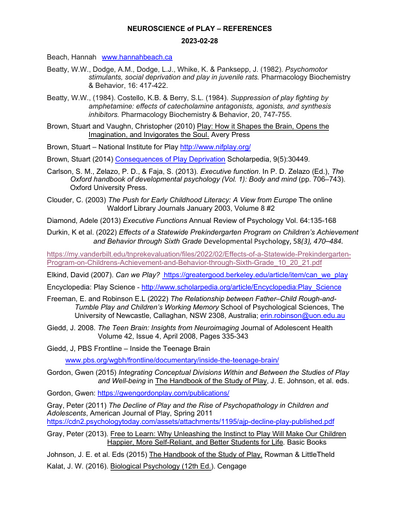
NEUROSCIENCE of PLAY – REFERENCES
2023-02-28
Beach, Hannah www.hannahbeach.ca
Beatty, W.W., Dodge, A.M., Dodge, L.J., Whike, K. & Panksepp, J. (1982). Psychomotor stimulants, social deprivation and play in juvenile rats. Pharmacology Biochemistry & Behavior, 16: 417-422.
Beatty, W.W., (1984). Costello, K.B. & Berry, S.L. (1984). Suppression of play fighting by amphetamine: effects of catecholamine antagonists, agonists, and synthesis inhibitors. Pharmacology Biochemistry & Behavior, 20, 747-755.
Brown, Stuart and Vaughn, Christopher (2010) Play: How it Shapes the Brain, Opens the Imagination, and Invigorates the Soul. Avery Press
Brown, Stuart – National Institute for Play http://www.nifplay.org/
Brown, Stuart (2014) Consequences of Play Deprivation Scholarpedia, 9(5):30449.
Carlson, S. M., Zelazo, P. D., & Faja, S. (2013). Executive function. In P. D. Zelazo (Ed.), The Oxford handbook of developmental psychology (Vol. 1): Body and mind (pp. 706–743). Oxford University Press.
Clouder, C. (2003) The Push for Early Childhood Literacy: A View from Europe The online Waldorf Library Journals January 2003, Volume 8 #2
Diamond, Adele (2013) Executive Functions Annual Review of Psychology Vol. 64:135-168
Durkin, K et al. (2022) Effects of a Statewide Prekindergarten Program on Children’s Achievement and Behavior through Sixth Grade Developmental Psychology, 58(3), 470–484.
Elkind, David (2007). Can we Play? https://greatergood.berkeley.edu/article/item/can_we_play
Encyclopedia: Play Science - http://www.scholarpedia.org/article/Encyclopedia:Play_Science
Freeman, E. and Robinson E.L (2022) The Relationship between Father–Child Rough-and-Tumble Play and Children’s Working Memory School of Psychological Sciences, The University of Newcastle, Callaghan, NSW 2308, Australia; erin.robinson@uon.edu.au
Giedd, J. 2008. The Teen Brain: Insights from Neuroimaging Journal of Adolescent Health Volume 42, Issue 4, April 2008, Pages 335-343
Giedd, J, PBS Frontline – Inside the Teenage Brain www.pbs.org/wgbh/frontline/documentary/inside-the-teenage-brain/
Gordon, Gwen (2015) Integrating Conceptual Divisions Within and Between the Studies of Play and Well-being in The Handbook of the Study of Play, J. E. Johnson, et al. eds.
Gordon, Gwen: https://gwengordonplay.com/publications/
Gray, Peter (2011) The Decline of Play and the Rise of Psychopathology in Children and Adolescents, American Journal of Play, Spring 2011
https://cdn2.psychologytoday.com/assets/attachments/1195/ajp-decline-play-published.pdf
Gray, Peter (2013). Free to Learn: Why Unleashing the Instinct to Play Will Make Our Children Happier, More Self-Reliant, and Better Students for Life. Basic Books
Johnson, J. E. et al. Eds (2015) The Handbook of the Study of Play. Rowman & LittleTheld
Kalat, J. W. (2016). Biological Psychology (12th Ed.). Cengage
References
Lillard, A., & Else-Quest, N. (2006). Evaluating Montessori education. Science, 313 (5795), 1893–1894. https://doi.org/10.1126/science.1132362
Liu, C. (2017). Neuroscience and learning through play: a review of the evidence – White Paper November 2017 https://www.legofoundation.com/media/1064/neuroscience-review_web.pdf
McGilchrist, Iain (2010). The Master and his Emissary http://iainmcgilchrist.com/
McGilchrist, Iain Interview on NPR (2019) - https://www.npr.org/2019/02/01/690656459/one-head-two-brains-how-the-brains-hemispheres-shape-the-world-we-see
Panksepp, J. (2004). Affective Neuroscience: The Foundations of Human and Animal Emotions. Oxford University Press
Panksepp, J. (2007). Can PLAY Diminish ADHD and Facilitate the Construction of the Social Brain? J Can Acad Child Adolesc Psychiatry 16:2 May 2007
Panksepp, J. (2010). THE IMPORTANCE OF PLAY interview with Passion Jun M.D. in Brain World https://brainworldmagazine.com/the-importance-of-play-an-interview-with-dr-jaak-panksepp/
Panksepp, J and Six, S. (2012). ADHD and Play Scholarpedia, 7(10):30371.
Pellis SM, Pellis VC. (2007) Rough-and-Tumble Play and the Development of the Social Brain Current Directions in Psychological Science, 16(2), 95–98
Pellis SM, Pellis VC. (2009) The Playful Brain: Venturing to the Limits of Neuroscience. Oxford, United Kingdom: One world Publications
Pellis SM, Pellis VC, Bell HC. (2010) The function of play in the development of the social brain. Am J Play. 2010; 2:278–296
Bell HC, Pellis SM, Kolb B. (2010) Juvenile peer play experience and the development of the orbitofrontal and medial prefrontal cortices. Behav Brain Res.;207(1):7–13
Pellis SM, Pellis VC, Himmler BT. (2014) How play makes for a more adaptable brain: a comparative and neural perspective. Am J Play.;7(1):73–98
Pellis, S. and Pellis V. (2013). Rough and Tumble Play Scholarpedia, 8(3):30363
Porges, S. (2011) The Polyvagal Theory. W.W. Norton
Schweinhart, Larry J. and D. P. Weikart. 1997. The High/Scope Pre-school Curriculum Comparison Study through age 23. Early Childhood Research Quarterly 12. pp. 117-143.
Siegel, D. (2001) The developing mind: How relationships and the brain interact to shape who we are. Guilford Press
StGeorge, Jennifer M et al. (2021) Quality and Quantity: A Study of Father–Toddler Rough-and-Tumble Play Journal of Child and Family Studies volume 30, pages 1275–1289
Steinberg, L. (2004). Risk-taking in adolescence: What changes, and why? Annals of the New York Academy of Sciences, 1021, 51–58. Volume 16—Number 2 59
Suggate, S.P. (2012) Children learning to read later catch up to children reading earlier Early Childhood Research Quarterly 28(1)
PLAY COURSES BY GORDON NEUFELD, PhD
Play 101: a primer for parents, teachers and therapists: https://neufeldinstitute.org/course/play-101-a-primer-for-parents-teachers-and-therapists/
Play and Attachment: https://neufeldinstitute.org/course/play-and-attachment/
Play and Emotion: https://neufeldinstitute.org/course/play-and-emotion/