-
- No matching results found.
- Watch history
- Download
- High (1080p)
- Medium (720p)
- Low (540p)
- Audio
- Original
Navigating Neurodiversity
an IDEA Centre webinar featuring Catherine Korah - February 2024
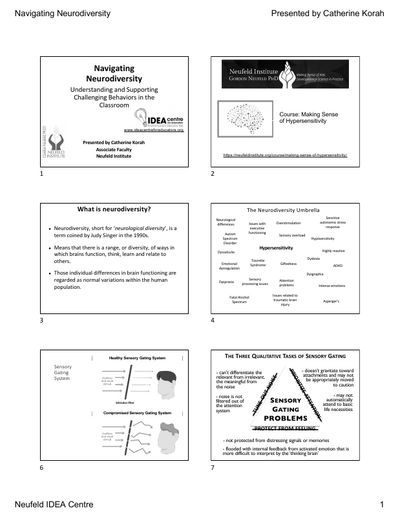
Navigating Neurodiversity Presented by Catherine Korah
Navigating Neurodiversity
Neufeld Institute
Making Sense of Kids Developmental Science in Practice
Understanding and Supporting Challenging Behaviors in the Classroom
IDEA centre for educators
www.ideacentreforeducators.org
Presented by Catherine Korah
NEUFFLD Associate Faculty
Neufeld Institute
https://neufeldinstitute.org/course/making-sense-of-hypersensitivity/
1
2
What is neurodiversity?
The Neurodiversity Umbrella
Neurodiversity, short for ‘neurological diversity’, is a term coined by Judy Singer in the 1990s.
- Means that there is a range, or diversity, of ways in which brains function, think, learn and relate to others.
- Those individual differences in brain functioning are regarded as normal variations within the human population.
| Neurological Differences | Issues with Executive Functioning | Overstimulation | Sensitive Autonomic Stress Response |
|---|---|---|---|
| Autism Spectrum Disorder | Hypersensitivity | Highly Reactive | ADHD |
| Dyscalculia | Emotional Dysregulation | Tourette Syndrome | Dyslexia |
| Dysgraphia | Dyspraxia | Sensory Processing Issues | Attention Problems |
| Intense Emotions | Issues Related to Traumatic Brain Injury | Asperger's | |
| Fatal Alcohol Spectrum |
3
4
Healthy Sensory Gating System
THE THREE QUALITATIVE TASKS OF SENSORY GATING
| Sensory Gating | Auditory and Visual Stimuli |
|---|---|
| Stimulus Filter | Compromised Sensory Gating System |
| Prioritize Attention | - can’t differentiate the relevant from irrelevant, the meaningful from the noise |
| Tune Out Noise | - noise is not filtered out of the attention system |
| Sensory Gating Problems | - may not automatically attend to basic life necessities |
| Protect from Feeling | - not protected from distressing signals or memories |
| - flooded with internal feedback from activated emotion that is more difficult to interpret by the ‘thinking brain’ |
Neufeld IDEA Centre
Navigating Neurodiversity Presented by Catherine Korah
CHECKLIST FOR SENSORY GATING PROBLEMS
| HIGHLY SENSITIVE | HYPER SENSITIVE | |
|---|---|---|
| enhanced sensorium; normal sensory input can be painful, overwhelming and even unbearable | working sensory gating system - more likely to be defended against distressing perceptions, memories or feelings | dysfunctional sensory gating system - less able to forget distressing events or not be affected by what they cannot tune out BUT also less able to interpret distressing feelings and perceptions |
| spontaneous attempts at signal patterning, noise reduction, reducing excitation, or using white noise to create a focus | more able to tune out in stimulating environments | more likely to avoid stimulating environments, if possible, because they cannot tune out |
| difficulty with selective attention – easily distracted by extraneous and irrelevant input which they can become ‘experts’ at | more likely to focus on priorities and not notice or forget the rest | more likely to neglect priorities and thus notice and remember incidental details instead |
| not protected from seeing or sensing what distresses; typically a good memory for distressing events | more likely to be defended against social cues that could make them feel bad | less able to properly read and interpret subtle social cues |
| less able to function in wounding or distressing situations | more likely to attempt to focus when input is overwhelming | more likely to attempt to pattern stimulation when input is overwhelming |
AN ESTIMATE OF HYPERSENSITIVITY AS A ROOT CAUSE OF THE SIGNS AND SYMPTOMS ASSOCIATED WITH THESE SYNDROMES
| 100% | |
|---|---|
| AUTISM | |
| ASPERGERS | |
| GIFTEDNESS | |
| ADD | |
| Percentage of diagnoses | O% |
EXECUTIVE FUNCTIONING
The set of cognitive processes that allows us to do things like plan, prepare, problem-solve, judge time, focus attention, self-regulate, and remember steps to a plan. Neurodivergent students commonly demonstrate differences in executive functioning.
PROBLEM
SOCIAL
IMPULSE
SOLVING
TIME
SKILLS
Judgment last to develop. The area of the brain that controls "executive functions" — including among the last to fully mature. Brain development from childhood to adulthood:
| 5-year-old brain | Preteen brain | Teen brain | 20-year-old brain |
|---|---|---|---|
| Front | Top | Back | |
| Red/yellow: Parts of brain less fully mature | Blue/purple: Parts of brain more fully mature |
Image from the National Institute of Mental Health; Paul Thompson, Ph.D., UCLA Laboratory of Neuro Imaging
on the one hand my needs the needs of others on the other hand emotions reason
Executive functioning requires the activation of, and access to, the pre-frontal cortex part of the brain. However, the development of the prefrontal cortex relies on the individual being in a state of rest and safety.
Neufeld IDEA Centre 2
Navigating Neurodiversity Presented by Catherine Korah
EXECUTIVE FUNCTIONING
Sensory processing differences
| Visual | Auditory | ||
|---|---|---|---|
| Sense of sight | Sense of sound | ||
| Info. received through the eyes | Info. received through the ears | ||
| Olfactory | Tactile | Gustatory | |
| Sense of smell | Sense of touch | Sense of taste | |
| Info. received through the nose | Info. received by contact through the skin | Info. received through the mouth |
They may have challenges with everyday tasks that are easy to take for granted, such as:
- keeping an organized desk
- turning in finished work
- not shouting out answers in class
- reading social cues
- response flexibility – accepting change
- maintaining focus on instruction or the task at hand
Adults in this child’s world need to provide the scaffolding that normally would be provided by the Executive Functions.
Interoception
Vestibular
Proprioception
Awareness of internal bodily states
Sense of balance and spatial orientation
Awareness of body in space and strength needed to complete actions
HYPER sensory processing
Many neurodivergent individuals experience differences in how they perceive and process sensory information. A person may have sensory preferences or dislikes/aversions in each of the 8 domains of sensory processing.
- Hypertactile: pull away when people try to hug them, avoid washing hair or cutting nails, refuse to wear certain clothes, react to heat/cold, avoid wearing shoes, avoid getting ‘messy’ and dislike certain texture of foods.
- Acute vision: notice the tiniest pieces of fluff on the carpet, complain about air particles flying, dislike bright lights, have difficulty with eye contact, may be frightened by sharp flashes of light.
- Hyperhearing: light sleeper, frightened by sudden unpredictable sounds, dislike thunderstorm and crowds, often cover their ears.
- Olfactory/Gustatory hypersensitivity: cannot tolerate how some people or objects smell, picky eater (taste or smell of certain foods), may gag/vomit easily.
Vestibular hypersensitivity: difficulty changing directions and walking or crawling on uneven or unstable surfaces, feel disoriented after spinning, jumping or running, may express fear of having the feet leave the ground.
Proprioceptive hypersensitivity: may lead to physical awkwardness, might have difficulty manipulating small objects.
Interoceptive hypersensitivity: may be overwhelmed by feelings that are a part of the body's day-to-day functioning, own heartbeat can be distracting, lower tolerance threshold to hunger and pain.
Sensory input levels and learning
What is stimming?
Self-stimulatory behaviour – a repetitive action or movement of the body:
- rocking back and forth
- flapping hands
- flicking fingers, or repetitive motions with the fingers
- watching something intensely or on repeat
- chewing or mouthing items
- spinning or twirling
- making repeated noises
Stimming is a common adaptive behaviour that serves an important purpose.
Neufeld IDEA Centre 3
Navigating Neurodiversity Presented by Catherine Korah
Stimming serves a purpose
SELF-REGULATION. Stimming can:
- distract from or dampen sensory input from outside sources
- enhance or provide additional sensory input
- help manage emotions and/or sensations
- help bring to a state of calm
- help to handle stress or overwhelming paces/events
COMMUNICATION/EXPRESSION. Stimming can:
- be a form of expression to release strong feelings or reactions
- communicate frustration, fear, overwhelm, etc.
- also communicate joy, excitement, happiness, etc.
ENJOYMENT. Stimming can:
- just be done because it feels enjoyable, and that’s okay.
- Stimming should be honoured and left to complete its purpose, unless it is harming to the individual or to others.
– Temple Grandin, American Academic and Autism Spokesperson
The deal with empathy
- It is a MYTH that ND individuals don’t feel empathy for others.
- They may experience Alexithymia: emotional processing difference that leads to challenges in identifying and describing your own emotions.
- There are different types of empathy:
- Emotional empathy: feeling/experiencing another person’s emotions.
- Cognitive empathy: identifying and understanding how another person is thinking in relation to that feeling.
- Studies* have shown that:
- ND individuals may have a surplus of emotional empathy (even empathic “hyperarousal”).
- What they may have less of is identifying/understanding what the emotion is and why it’s occurring.
https://link.springer.com/article/10.1007/BF03395663
WHAT DOESN’T WORK
Neurotypical expectations and masking
Reasons for masking (whether conscious or unconscious):
- Fitting in or trying to uphold social norms in order to feel a sense of belonging
- Keep oneself safe from bullying, judgment, or stigma
- Performing at school or in activities
- Trying to make friends
- Not meaning to mask, but doing so out of a learned need or habit
Masking can be extremely:
- stressful
- exhausting
- creates dysregulation
- could lead to burnout
Studies* have shown that masking can lead to some extremely negative outcomes, including higher rates of depression and suicidal ideation.
https://pubmed.ncbi.nlm.nih.gov/29071566/
https://journals.sagepub.com/doi/full/10.1177/2156869318804297
Neufeld IDEA Centre
Navigating Neurodiversity Presented by Catherine Korah
WHAT DOESN’T WORK
Conventional Classroom Management and Problem Behaviour Centered Intervention
- Rewards/Consequences
- Behaviour management tracking systems
- Being sent to the Principal’s office
- Detention/Reflection Room
- Student behaviour contract
- Zero tolerance discipline measures
- Suspensions
It doesn’t help change or improve student behaviour and it exacerbates the problem with neurodivergent students.
WHAT DOESN’T WORK
Compliance-based strategies
Compliance-based strategies teach a dangerous precedent to an already vulnerable community: “I have to do what you say, regardless of how I feel about it”. It puts ND individuals in a position of being at risk for future abusive situations.
Compliance-based strategies often ask a student to mask, or to adhere to neurotypical norms. Masking can be detrimental to the mental and physical health of ND students.
Compliance-based strategies do not validate the internal feelings and/or needs of ND individuals. They also overlook critical development areas, such as self-awareness and self-advocacy.
WHAT DOESN’T WORK
Using the student’s joys and interests as a reward
- Keeping students' favorite items and activities kept away from them in order to use them as reinforcers for work. ("First work, then dinosaurs")
- While believing that this will motivate students to complete tasks, the reality is that these joys, interests and comforts are being withheld from students.
- This has an effect on motivation, feelings of safety and comfort, and teaches neurodivergent children compliance for the sake of compliance: "You tell me what to do and I have to do it, or I don't get something I need or love."
- Studies have shown that using rewards to motivate actually decreases the response rates by weakening intrinsic motivation, showing that rewards aren’t long-term successful motivators.
- The same studies have also found that genuine encouragement, in the context of a strong and supportive relationship (not gratuitous praise), improved response rates by increasing intrinsic motivation. Connection is more motivating than tangible rewards!
Carton, JS - 1996
TWO BASIC GUIDELINES FOR INTERVENTION
RULE #1 – RETREAT to RELATIONSHIP
- The attachment of the child to the adults involved is the context for dealing with the immature as well as for dealing with problems of any kind.
- Treat the relationship if needed.
- Treat through the relationship when possible.
- The first focus should be the attachments of the child to the parents (or surrogate parents).
RULE #2 – RETREAT to PLAY
- Play is the default mode of childhood and as well as the context for development, including brain development.
- The play mode is where the brain’s internal defenses are relaxed, setting the stage for healing and recovery.
- Find a way to reduce the social repercussions of the sensory reducing habits and tics.
- Assume responsibility for walking the maze together, finding the ways the brain can function best.
Neufeld IDEA Centre 5
Navigating Neurodiversity Presented by Catherine Korah
PREVENTION and INTERVENTION
CEBM Pyramid of TIER 1 – UNIVERSAL Practices in the Classroom
Key factors in supporting challenging students Inspired by the RTI Model of Responses to Intervention
| 1-7% | FEW | Benefit from individualized supports | |
|---|---|---|---|
| 5-15% | SOME | Benefit from targeted supports | |
| ALL | 80-85% | Benefit from school-wide supports |
https://www.cebmmember.ca/pyramid-of-interventions https://www.cebmmember.ca/tier-1-universal-practices
TIER 1 – UNIVERSAL Practices in the Classroom
- At Tier 1, the classroom supports benefit the group as a whole.
- These are daily practices led by the Homeroom Teacher and the Specialists.
- The focus is on PREVENTION:
- Setting up the physical and social environment of the classroom with an ND individual in mind
- Using inclusive practices that move away from neurotypical norms and that don’t push ND students to mask
- Offering an array of tools and resources to answer to a range of needs, differences, and interests
MINIMIZING SENSORY INPUT
Be aware that your classroom decor may be overstimulating to a neurodivergent student. While the decor may appear fun to you, lots of bright colors with no place for the eyes to rest could be hard on the sensory system of ND students in the classroom.
Consider toning down the decor to include:
- fewer decorations
- less intense colors
- a place (perhaps towards the front of the classroom) where a child can rest his or her eyes
You’ll likely find a less stimulating classroom to be beneficial for neurotypical children as well as for ND students.
https://www.cebmmember.ca/tier-1-universal-practices
MINIMIZING SENSORY INPUT
PRIVACY CARREL
| Lining up Expectation | Body | Quiet |
|---|---|---|
| Hands to yourself | One behind each |
MODIFYING NEON LIGHTS
ARE THESE REALISTIC?
Neufeld IDEA Centre 6
Navigating Neurodiversity Presented by Catherine Korah
Flexible Classroom
Supporting executive functioning
- ADAPT THE ENVIRONMENT.
- add physical barriers, reduce distractions, use homework bins, seat child to promote attention.
- ESTABLISH ROUTINES AND SCHEDULES.
- routine chart, visual calendar.
- HELP WITH ORGANIZATION AND TIME MANAGEMENT.
- make it easy to access necessary materials – pencils, work folder, paper, scissors etc. – have extra at hand
- provide tools and strategies (e.g. bins/labels, visual reminders, checklists, time-timer, wonder clock, etc.)
- break tasks into manageable steps
- homework – keep to the essential – identify what must absolutely be done
- OUTLINE STEPS.
- https://www.cebmmember.ca/individual-work-stations
- use checklists that outline steps and procedures (e.g. Ready-Do-Done model).
Supporting executive functioning
Elementary– seat work
- Divide work into small chunks
- When focus wanders –
- redirect to completing one small step
- fold the paper
- highlight the ones you want completed
- Provide encouragement and support – swing by often
- Prioritize the important work
- Accept that some work won’t be completed
- It is more important that the student gets a feeling of accomplishment and senses that you value his/her EFFORTS.
CLASSROOM BRAIN BREAKS
-
As movement is incorporated into the daily classroom routine
-
the brain is able to function at higher levels,
-
stress and anxiety are reduced
-
Improves STAYING ON TASK
-
Increases ATTENTIVENESS
-
Restores ENERGY AND MOTIVATION
-
Be mindful of overly stimulating activities – provide options
PROVIDING TOOLS
- Create a sensory retreat for the student
- Include sensory breaks as part of the school day
- Figure out which sensory tools works best for the student
- Provide choices for sensory input opportunities
- Make sensory activities fun and engaging
- Help the student to recognize their internal cues and when they need a break
Neufeld IDEA Centre 7
Navigating Neurodiversity Presented by Catherine Korah
QUIET CORNER IN THE CLASSROOM
HOW TO INTRODUCE FIDGET TOOLS AND OTHER SENSORY MATERIALS
A resource available for all students in the group
Benefits for:
- the student
- the group
- the teacher
Adapted to the age group/grade level
- ü noise cancelling headsets
- ü fidget toys
- ü weighted items
- ü favourite calming items
Structure
Introduce the materials. Explain and model how they are intended to be used. Make sure students understand it’s a tool and not a toy.
Have students explore their own unique sensory preferences.
Set up parameters and clear expectations around the What-When-Where and for how long.
Set up an Individual Bin for that student in which the selected materials can be placed.
Safety
Students need to be reminded and coached to ensure safe use of the different tools and taking care of the materials at their disposal.
https://www.cebmmember.ca/cocoon-area 53
TIER 2 – TARGETED Practices in the Classroom and School
At Tier 2, the student requires a more targeted support.
These supports measures and accommodations are meant to be assigned to or scheduled for the ND student.
Practices lead by the Homeroom Teacher and the Specialists with the help of Support Staff and Resource Teacher.
The student continues to benefit from Tier 1 supports in addition to supplemental Tier 2 measures.
https://www.cebmmember.ca/tier-2-targeted-practices
CHECK-IN with a significant adult
Scheduled Movement Station
In the Classroom
- To inquire about their morning and how they are feeling
- To provide SUPPORT for the day in manageable pieces
- To remind the student of their resources and strategies
- To alert significant adults if the student NEEDS HELP
https://www.cebmmember.ca/tier-2-targeted-practices
https://www.cebmmember.ca/physical-outlet-movement-station
Neufeld IDEA Centre 8
Navigating Neurodiversity Presented by Catherine Korah
TIER 2 – TARGETED tools/measures
that are assigned to the student
- Preferential seating, alternate seating, and alternate workstation.
- Individual bin with pre-selected tools and materials.
- “You’ve Got Mail” support in a pre-determined location and designated adult.
- Small-group accompaniment during transition times (e.g. supported recess/lunch).
Contains:
- activities to engage the student if they need a moment of respite.
- less demanding educational work.
- can be easily transported to another location or another room.
https://www.cebmmember.ca/tier-2-targeted-practices
“You’ve Got Mail” Transition with a Destination
“You’ve Got Mail” letters provide something tangible for a student to hold as they head to a pre-determined destination for a short period of time.
Two types of letters are available:
- Active movement
- Quiet activity
https://www.cebmmember.ca/tier-2-targeted-practices
TIER 3 – INDIVIDUALIZED Practices
with the help of Support Staff and/or Professionals
- At Tier 3, the student requires a more intensive and individualized measures. One-to-one support is needed.
- These accommodations and adaptations are tailored to the student’s individual needs and interests. The student may require an adapted schedule as well.
- A collaboration is needed between the school team, the board consultants/professionals, the parents, as well as outside partners (if present).
- The student continues to benefit from T1 and T2 supports in addition to supplemental T3 measures.
https://www.cebmmember.ca/tier-3-individualized-practices
Support Interventions during TRANSITIONS
4 Personalized support measures for:
- Transitions/Hallway
- School yard (supported recess)
- Lunch time (sheltered lunch)
- Daycare
- School bus
https://www.cebmmember.ca/tier-3-individualized-practices
Neufeld IDEA Centre 9
Navigating Neurodiversity Presented by Catherine Korah
COMPENSATE for sensory gating problems
- assume responsibility to collect the child and their attention
- assume responsibility to reduce stimulation where possible
- help create artificial blinders to aid in focus and concentration
- help create white noise filters to increase ability to focus
- help find ways of reducing ‘noise’ and patterning sensory input
SUPPORT AND COMPENSATE
| When? | Where? | With whom? |
|---|---|---|
| Recess / Breaks | ü With extra supervision | ü Organized activity |
| • Hallways | ü Away from other students | |
| • Bathrooms | ü Under supervision | |
| • Lunch time | ü In a quieter space | |
| • Substitute teacher | ü Make introductions or | |
| ü Have an alternate “person” the student can be with |
Work with your school team to change the circumstances rather than just trying to control or change the student.
USE TIME AWAY INSTEAD OF TIME OUT
KNOW YOUR LIMITS AND WORK WITHIN THEM
If you are starting to “reach your limit” with a student:
- Send the student to another place
- The “Quiet Corner” in the classroom
- Send the student TO SOMEONE with a “task”
- a book or an envelope or “You’ve got mail”
- ü Another adult – counsellor, school secretary
- ü Nurturing Support Centre
- Always go to the student and let them know that the relationship is still intact and that you will take care of them the next day.
NURTURING SUPPORT CENTRE (NSC)
- Provide student with passes to visit the NSC, to work, to talk, to have supervised ‘alone time’
- Participation in ‘interest clubs’ with adult supervision during recess and lunchtime
- Sheltered recess and/or sheltered lunch in a predetermined location (small group) – orchestrate the schedule to ‘divide & conquer’ clusters of students who struggle together
https://www.cebm.ca/nurturing-support-centre
Neufeld IDEA Centre 10
Navigating Neurodiversity Presented by Catherine Korah
Supporting feelings and emotions
Importance of CO-REGULATION
Co-regulate with them.
- Many ND students experience intense and overwhelming emotions
- They don’t always have a way to communicate or to regulate them effectively.
- They need us to model and support them in co-regulating their emotions.
| Regulated Adult | Regulated Child | Regulated Child |
|---|---|---|
| + | ||
| Regulated Adult | Dysregulated Child | Regulated Child |
| + | *A | |
| Dysregulated Adult | Regulated Child | Dysregulated Child |
| R | ||
| Dysregulated Adult | Dysregulated Child | Dysregulated Child |
Validate their emotions.
- Sometimes we describe their emotional experience for them “No Johnny, this is a SMALL problem; you don’t need to be upset”.
- Instead, let your student know their emotions are valid.
- Try “I understand that this is important to you and that it’s upsetting”.
- Talk about the situation and help draft some possible next steps, if needed and if the student is receptive.
Supporting feelings and emotions
Provide supports.
- Sometimes we over-emphasize the importance of using words to describe our emotions.
- If this approach is difficult for your student, try another method (e.g. visual support).
Make it part of everyday life.
- Don’t wait until the student is experiencing strong emotions to practice using the tools and strategies.
- Practice these regularly to normalize using them and during times when the student is regulated so they are in a better place to be trying and adjusting them.
The personal choice board provides clear boundaries and safe options to release energy and/or expression emotions.
https://www.cebmmember.ca/personal-bin
EMOTIONS
A PLACE TO LET IT OUT
‘calming down’ will come naturally once the emotion has been released
SUPPORTING THE STUDENT’S GROWTH
Find a balance between “Pushing” and “Protecting”
- Recognize when the child has reached a “limit” of being stirred up and needs pressure to be removed
- Encourage the child to try challenging activities but in small steps.
Remember that these children experience higher cortisol levels for “normal” stressors than other children. We need to help them to tolerate some level of “stress” but not too much.
https://www.cebm.ca/emotions-room
Neufeld IDEA Centre 11
Navigating Neurodiversity Presented by Catherine Korah
BRIDGE THE FALLOUT OF THE SENSITIVITY REACTION
SCHOOL TEAM
A difficult day
- “I am looking forward to seeing you tomorrow.”
- “We’ll find a way to make things better.”
- “We’ll try again tomorrow.”
Focus on the next point of contact
- Use your existing school team to plan regular meetings to discuss students with challenging behaviours, and how best to help support them so they can handle being in school.
- Put together a team of adults to share the responsibility of caring for these students.
- Use adult resources in the school creatively.
- Identify one “key” adult to connect with the student – to try for a regular check-in or recap at the end of the day by means of another activity e.g. breakfast programme, recycling, exercise “group”.
The message we want to give our youth is that NO MATTER WHAT they DO or how they BEHAVE ADULTS WILL CONTINUE TO CARE FOR THEM. BRIDGING gives the student HOPE.
KEY INTERVENTIONS FOR THE HYPERSENSITIVE
CEBM
Also visit the CEBM Resource Center
THE CENTRE OF EXCELLENCE FOR BEHAVIOUR MANAGEMENT (CEBM)
IDEA Centre for Educators
1.
Keeping them SAFE is of utmost importance and can only be done by assuming a strong ALPHA role and by providing plenty of time in emotional PLAYGROUNDS.
2.
Be PATIENT with their emotional maturation, as having intense signals renders them much less likely to become tempered in experience & expression until 2 or 3 years later than the normal 5-7 shift, even if conditions are conducive. The best way to help is to make it easy for them to find their MIXED FEELINGS.
3.
Make sure to access their SADNESS, as feeling the futility they encounter will be the key to developing the resilience to deal with a wounding world, to venting their intense emotions, and to the brain finding work-arounds for what isn’t working.
4.
Provide plenty of access to emotional PLAYgrounds, as this will provide the REST they require, keep their hearts SOFT, help them to access SADNESS one step removed, RELEASE their intense feelings, and facilitate needed repair and RECOVERY.
www.ideacentreforeducators.org
Neufeld IDEA Centre 12