-
- No matching results found.
- Watch history
- Download
- High (1080p)
- Medium (720p)
- Low (540p)
- Audio
- Original
Working with Diverse Student Needs with Eva de Gosztonyi
Download Eva's slides below. In the recording Managing Behaviour Without Rewards Eva de Gosztonyi expands on the subject.
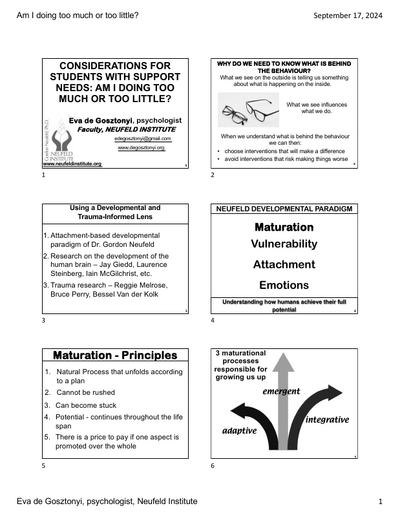
Am I doing too much or too little? September 17, 2024
CONSIDERATIONS FOR STUDENTS WITH SUPPORT NEEDS: AM I DOING TOO MUCH OR TOO LITTLE?
Eva de Gosztonyi, psychologist
Faculty, NEUFELD INSTITUTE
NEUFELD
WHY DO WE NEED TO KNOW WHAT IS BEHIND THE BEHAVIOUR?
What we see on the outside is telling us something about what is happening on the inside.
What we see influences what we do.
When we understand what is behind the behaviour we can then:
- choose interventions that will make a difference
- avoid interventions that risk making things worse
Using a Developmental and Trauma-Informed Lens
- Attachment-based developmental paradigm of Dr. Gordon Neufeld
- Research on the development of the human brain – Jay Giedd, Laurence Steinberg, Iain McGilchrist, etc.
- Trauma research – Reggie Melrose, Bruce Perry, Bessel Van der Kolk
NEUFELD DEVELOPMENTAL PARADIGM
| Maturation | Vulnerability | Attachment | Emotions |
|---|---|---|---|
| Understanding how humans achieve their full potential |
Maturation - Principles
- Natural Process that unfolds according to a plan
- Cannot be rushed
- Can become stuck
- Potential - continues throughout the life span
- There is a price to pay if one aspect is promoted over the whole
3 maturational processes responsible for growing us up
- emergent
- integrative
- adaptive
Eva de Gosztonyi, psychologist, Neufeld Institute
1
Am I doing too much or too little? September 17, 2024
EMERGENT PROCESS
THE EMERGENT CHILD
- curious
- has plans
- own ideas and values
- creative
- full of vitality
- sense of responsibility
- independent
- aware of other’s boundaries
- shifts easily into emergent play
A SEPARATE BEING
capable of functioning SEPARATELY & INDEPENDENTLY
Vulnerability Principles
Too much separation
Too much shame
Too much alarm
- Growth requires softness – which means being vulnerable.
- When the brain senses it is too vulnerable, it protects itself
- When the brain is protecting itself, it cannot be growing.
• It’s not safe to express what I am feeling.
• It’s not safe to depend or be vulnerable.
• The world is overwhelming (including hypersensitivity) and there is no one who can keep me safe.
INTERACTIVE FACTORS
SENSITIVITY X STRESSORS
- The perception of what makes us feel vulnerable is individual.
- High sensitivity increases feelings of vulnerability.
- Complex trauma (Adverse Childhood Experiences) increase feelings of vulnerability.
• genetics
• pre-natal stressors
• stressors at birth
• too much separation
• being too alarmed or for too long
• feeling too much shame or that something is wrong with you
Eva de Gosztonyi, psychologist, Neufeld Institute
Am I doing too much or too little? September 17, 2024
ATTACHMENT
Attachment Principles
Every day our children wonder:
Who is taking care of me?
- Attachment is the primary need of a developing being.
- Growth takes place in the context of a safe Attachment.
- A “safe” Attachment figure both cares about and cares for (takes charge of) the dependent being.
- Being dependent requires the ability to tolerate vulnerability.
HOW DOES ATTACHMENT WORK?
What attachment does … enables adults to…
- Arranges hierarchically take charge of them, take care of them
- Renders endearing and tolerant like them and endure them
- Creates a sense of home provide comfort, rest and retreat
- Creates a compass point guide & direct them and transmit our culture
Attachment is organized hierarchically its primary purpose is to facilitate both the giving and receiving of CARE (educating)
There are two sets of complementary INSTINCTS DEPENDENT & ALPHA (to GUIDE), and two sets of DRIVES SEEKING and PROVIDING.
ALPHA INSTINCTS are wired into our brain
SEEKING
PROVIDING
| dependent instincts | instincts to guide |
|---|---|
| instincts to depend | (ALPHA instincts) |
| to get one’s bearings | to orient and inform |
| to seek assistance | to protect & defend |
| to look up to | to guide and direct |
| to belong | seeking to look out for |
| to follow | to possess |
| to lead and guide | |
| to look for guidance |
Eva de Gosztonyi, psychologist, Neufeld Institute
Am I doing too much or too little? September 17, 2024
SEEKING
PROVIDING
SEEKING
PROVIDING
dependent instincts
instincts to guide
dependent instincts
instincts to depend
(ALPHA instincts)
to get one’s bearings
to orient and inform
to seek assistance
ACTIVATES
to protect & defend
PROVIDING
to guide and direct
to look up to
ACTIVATES ALPHA
DEPENDENT INSTINCTS
to look out for
to possess
to lead and guide
to follow
to look for guidance
19
20
In order to serve the role of ‘provider’, our ATTENTIONAL MECHANISMS ARE SENSITIZED to signs of vulnerability and challenges to our alpha position.
PERCEIVED VULNERABILITY
- fear
- upset
- naïveté
- wounds
- confusion
- weakness
- defenseless
- helplessness
PERCEIVED ALPHA CHALLENGES
- talking back
- lack of respect
- lack of deference
- lack of submission
- lack of compliance
- lack of conforming
Moved to Assert Dominance, Assume Responsibility, Care For and Take Care Of
… TAKE THE ROLE OF LEADER – moved to take the lead
… ASSUME RESPONSIBILITY to make things work, to make sacrifices for but also to feel guilty
… CARE FOR AND TO CARE ABOUT to be concerned about, to help, to bear the burdens of, to meet the needs of, to provide what is needed
21
22
To fulfill the provider role, one must be …
SEEKING
PROVIDING
dependent instincts
instincts to guide
instincts to depend
(ALPHA instincts)
moved to
X moved to
moved
PROVIDING
to get one’s bearings
to orient and inform
to seek assistance
to protect & defend
PROVIDING
to look up to
to guide and direct
to belong
seeking
to look out for
to possess
to lead and guide
to follow
to look for guidance
RIGHT RELATIONSHIP
23
24
Eva de Gosztonyi, psychologist, Neufeld Institute
4
Am I doing too much or too little? September 17, 2024
CONDITIONS FOR RIGHT RELATIONSHIP
- sense of safety to depend
- trust that the adult is able to provide and keep safe
- kindness
- firmness
So that the child feels safe “leaning” on us.
So that the child knows the ADULT is ultimately the one who will make the final decision.
WHY DO CHILDREN HAVE TO LEAN ON ADULTS?
- If children won’t or can’t lean on the adults who are there for them, then they have to find someone else to take care of them.
- Many children then start to take care of themselves.
- Their Alpha Instincts become dominant and “stuck”, making these children very hard to teach and guide.
- Instead of allowing adults to guide and help them, they start telling adults what to do.
WHY DO WE HAVE TO BE AWARE OF THE IMPORTANCE OF ATTACHMENT?
Attachment is the natural context in which children are meant to be raised and educated.
To enable attachment to do its work, we need to ensure that children are actively attaching to the adults responsible for them.
When children are attached to us, they will follow our lead and learn from us.
THE EDUCATOR’S DILEMMA
WHEN DO I PUSH AND WHEN DO I HELP?
HOW DO I BLEND:
- MY MANDATE
- MY INSTINCTS
- THE CHILD’S NEEDS
GOAL: THE STUDENT WILL DRESS INDEPENDENTLY
MANDATE: To teach the child self-dressing skills and have him/her carry them out consistently
SITUATION THE CHILD:
- constantly asks for help before trying
- sits helplessly
- fools around
- starts crying
- refuses to dress
- has a “fit”
Possible Responses
| moved to DOMINATE | moved to ASSUME RESPONSIBILITY | moved to PROVIDING CARE and PROTECTING |
|---|---|---|
| INSIST | SCAFFOLD | DO IT FOR S/HE DOES IT |
| or COACH HIM/HER |
WHAT DO I DO?
WHICH ONE IS RIGHT?
Eva de Gosztonyi, psychologist, Neufeld Institute
Am I doing too much or too little?
September 17, 2024
THERE IS NO RIGHT ANSWER!
Being a caring ALPHA
As a caring ALPHA our role is to:
- be the ‘expert’ regarding your child
- Where is the child at developmentally?
READ THE NEED AND TAKE THE LEAD
- be the ‘expert’ regarding the child
- read the cues
- find the dance and take the lead
- meet needs and not demands – stay in charge
- provide more attachment than is being pursued
• The younger and more immature the child the more we need to respect their dependency needs.
• The desire to become INDEPENDENT is “wired” into us and manifests itself when DEPENDENCY needs are met.
• Have faith in the Developmental Process – patience if you want a “good one”.
Being a caring ALPHA
- be the ‘expert’ regarding your child
- Where is the child at in terms of vulnerability?
- What is going on in the child’s life?
- In his/her day?
- What is his/her fatigue level?
- Anything else that needs to be taken into consideration?
• What is going on in the child’s life?
• In his/her day?
• What is his/her fatigue level?
• Anything else that needs to be taken into consideration?
** When a child refuses to engage in a behaviour, or use a skill that they generally can do, we need to read this as a sign that something is going on.
Being a caring ALPHA
- read the cues
- Am I willing to take responsibility for pushing the child into a possible “crisis” or shut down?
- Is this the space or place?
- Is this the right time?
- Is it worth the fall out? Time, effort, resources, effect on the other students?
- Do I have the psychological energy to stay “tempered” in the midst of a meltdown or a stand off?
Being a caring ALPHA
- find the dance and take the lead
- Is this the time to INSIST?
- The child is functioning well and just needs a little encouragement
- The child is ready and able to find his sadness
- It is time for ADAPTATION to occur
Eva de Gosztonyi, psychologist, Neufeld Institute
Am I doing too much or too little? September 17, 2024
ADAPTATION
Being a caring ALPHA
PRIMING ADAPTATION
Being an AGENT OF FUTILITY
- Saying “No” firmly but kindly
- Allowing for a response – pouting, groaning, even some “name calling” (if it doesn’t cause problems with the other students)
- Being comfortable with tears and upset
Being an ANGEL of COMFORT for the feelings of futility and SADNESS
- Being comfortable with tears and upset
- Coming along-side the emotions: frustration, alarm
- Not changing your mind UNLESS the situation has spiraled out of control and you need to back away
HELPING THE TEARS TO FLOW
- Start by talking about and reflecting back the Emotion
- Frustration: “That didn’t work for you.” “That was not what you had in mind.”
- Alarm: “That was scary.” “You weren’t sure what was going to happen.”
- MATCH THE EMOTION.
- THEN: Move subtly towards SADNESS by allowing a tinge of sadness in your voice.
- USE SILENCE
- When the child starts to cry:
- DON’T ASK WHY
- If the child gives a reason, don’t MINIMIZE. If it seems trivial, it is usually because the child has an ocean of tears within them and can’t give all the reasons.
- When the tears start: SIT QUIETLY with compassion
- Trust in the “bounce back”
- Resist the natural alpha instinct to make things better or to problem solve
- Give lots of space to SADNESS and TEARS.
- Problem solve well after the tears (if needed)
SENSING ADAPTATION
When a child MOVES INTO in the ADAPTIVE mode an internal shift occurs which can be noted:
- the child may quiver, sigh, deep breaths and allow tears to go deeper
In that moment they come back into relationship with us. Our role is to be the midwives to an adaptive process – Adults are meant to keep this natural process on track.
HELPING THE TEARS TO FLOW
AN OLDER CHILD
- Sad movies, YouTube, sad story…
- In a dark room – in a dark car
- Shoulder to shoulder
- Slight tinge of sadness in voice
- Normalize sadness and tears
- Once tears appear, if resistant, CHANGE THE TOPIC BUT REJOICE IN THE SADNESS
Eva de Gosztonyi, psychologist, Neufeld Institute
Am I doing too much or too little? September 17, 2024
Being a caring ALPHA
D. MEET NEEDS AND NOT DEMANDS
HOW TO INVITE THE INEVITABLE while staying ALPHA
How else can we push or nudge besides insisting?
- “BENIGN NEGLECT”
- Finding something else to do
- Not interacting with the upset but not “ignoring” either
- Rejoicing in the tears
- Not over-reacting to the “success”
- SCAFFOLDING AND COACHING
- Start the process
- Give a suggestion or choice
- Don’t over-react to the “success”
- Keep your reaction low-key
• I know you are not going to like this.
• Go ahead and have the last word… have a fit…
• You may …
• It’s better that you don’t…
HOW TO CHANGE YOUR MIND while staying ALPHA
STAY IN CHARGE, EVEN IF YOU CAN’T BE IN CONTROL
IT’S NOT WHAT YOU DO, BUT HOW YOU DO IT.
Being a caring ALPHA
E. MAXIMIZE ATTACHMENT
provide more attachment than is being pursued
- To fulfill the child’s ATTACHMENT HUNGER
- To EVOKE the “dependent” instincts
- To allow the child to “rest” in the relationship
- COLLECT BEFORE YOU DIRECT
- Be sensitive to the “FACE” that the child sees when you are directing them
- Try to stay aware of how desperately children need us and make sure they “see” how you care for them
- Remember that growth happens when the brain is at rest – a child can only rest when they feel cared for
ENGAGE THE ATTACHMENT INSTINCTS
COLLECT BEFORE YOU DIRECT
When you find space, eyes, nod, smile that a student is no longer following your lead – go back to the beginning – use a collecting ritual
- Use an attachable tone
- Find a way to catch the student’s eyes, nod and smile – playful mode
- If you have to raise your voice to get the student’s attention, when s/he looks at you, have a smile in your eyes.
WORK AT ATTACHMENT AND ATTACHMENT WILL WORK FOR YOU
WHAT ARE WE AFRAID OF?
- What if he never learns this skill?
- Won’t she just end up being a “spoiled brat”?
- He’s just “manipulating us”.
- But if we don’t push, she’ll never improve.
Eva de Gosztonyi, psychologist, Neufeld Institute 8
Am I doing too much or too little? September 17, 2024
A DEVELOPMENTAL RESPONSE
WHAT ARE POSSIBLE CONSEQUENCES OF PUSHING TOO HARD?
- Behaviours and skills are more a result of GROWTH and DEVELOPMENT than they are of teaching and learning. We need to find the “sweet spot”.
- If the child is NOT ready, the learning won’t “stick” or generalize. The child performs the behaviour in the moment for the “reward” or to please us.
- Spoiling comes about when we:
- do not allow experiences with futility
- if we try to take away the natural reactions to futility i.e. emotional expression - attack/tantrums and tears.
- Of course, he’s trying to manipulate us – good for him! But WE DECIDE what is in the child’s best interest in that moment.
- Yes, we need to YEARN, GIVE IT A TRY, HAVE EXPECTATIONS but also respect the developmental rhythm.
WHAT ARE POSSIBLE CONSEQUENCES OF PUSHING TOO HARD?
The Attachment relationship can become disrupted, even if we are very positive
- Children are very sensitive to what we expect of them
- They go into Attachment Alarm if they are worried that they won’t be able to meet our expectations and lose our love – their anxiety increases
- Or they start tuning out everything we ask, because they think it is going to be TOO MUCH and they don’t want to disappoint us
Children start to PERFORM, instead of change coming from growth.
WHAT ARE POSSIBLE CONSEQUENCES OF PUSHING TOO HARD?
Children lose their Emergence (the natural desire to do more) and become passive and dependent on our reactions.
- The agenda is ours and not theirs.
- This includes when we use positive reinforcement or constant praise.
- Research has shown that rewards diminish natural impulse such as empathy. Warneken and Tomasello (2014) Extrinsic Rewards Undermine Altruistic Tendencies in 20-Month-Olds.
When children are constantly being taught, they lose out on valuable PLAY TIME which is where a lot of development actually takes place. When we take away “free play” or child-initiated play, we make it much harder for children to develop emotionally and intellectually.
Eva de Gosztonyi, psychologist, Neufeld Institute
Am I doing too much or too little? September 17, 2024
ENCOURAGE PLAY
HAVE FUN WITH THEM
Create time for play. Escalating diagnoses of childhood anxiety, depression and ADHD has paralleled the loss of Play - Peter Gray, American Journal of Play 2011. Playing and having fun with children and youth increases attachment - eyes, smiles, nods, bring a child into our orbit. The mutual joy and shared communication and attunement that adults and children can experience during play and fun regulate the body’s stress response.
PLAY TIME SHOULD NOT BE EARNED – it should be scheduled and protected. The more the child is IN TROUBLE, THE MORE HE/SHE NEEDS PLAY TIME.
COUNTERING COUNTERWILL
Being playful allows a way back into relationship and melts resistance without losing face. Increasing connection increases instinct to follow.
- Make routines fun:
The message we want to give our students is that we, the adults, will always find a way to care for them. BRIDGING gives the child HOPE.
THE DEVELOPMENTAL APPROACH
- We are gardeners, not sculptors
- Growth happens in rest, make sure the child has “down time”
- Rest happens when the child has “faith in the provision”
- When we give more than what is requested, our children lean into us, that allows them to rest, then they can grow
- Growth and development take time.
- Children are complex and full of many conflicting and challenging emotions: Frustration and Alarm which move them to Attack and Avoid. These cannot be eliminated.
- In fact, without Emotions, development is stunted
- Therefore, no ONE intervention will change a child’s behaviour – there is always Ebb and Flow
- The CONSISTENCY that children need is the knowledge that they can CONSISTENTLY count on us
HOW BEHAVIOUR CHANGES
- Maturation
- Behaviour changes as the brain matures
- Vulnerability
- Behaviour changes when vulnerability is protected
- Attachment
- Behaviour changes when students are attached to adults
- Emotions
- Behaviour changes when emotions are felt
Eva de Gosztonyi, psychologist, Neufeld Institute
10